
The Volcanic Plume Benchmarking (VPB) working group aims to improve the fundamental
understanding of volcanic plume dynamics and, ultimately, to improve the ability to forecast
the dispersion of volcanic ash during eruptive crises. Explosive volcanic plumes can produce
laterally spreading ash clouds or pyroclastic density currents, each of which presents
particular societal and environmental impacts. These are dangerous and devastating
phenomena, and, understandably, in situ data are rare to nonexistent. Volcanologists have
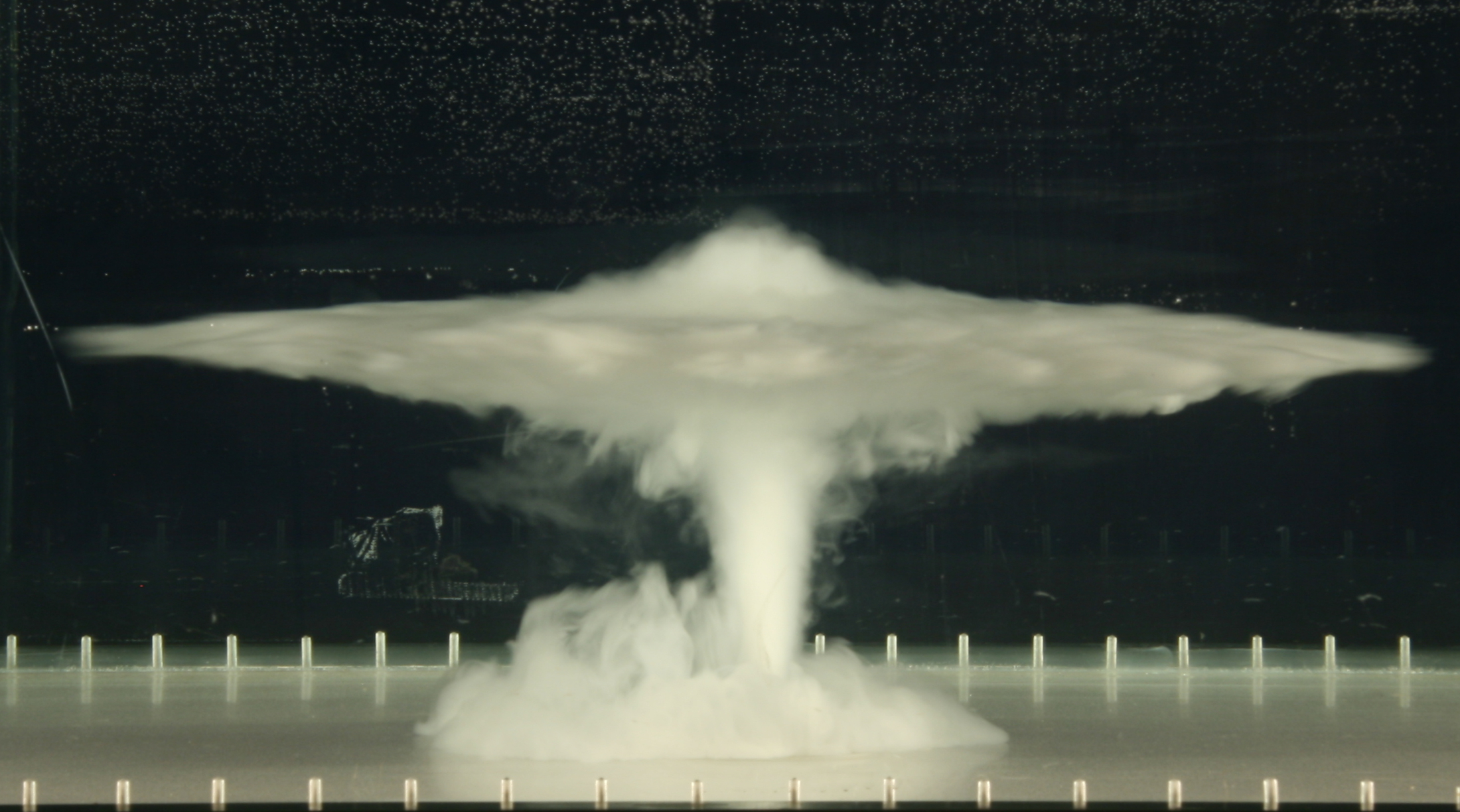
hence developed several strategies for the indirect study of eruption plumes: i) scaled
analogue experimental models using either water-particle or air-particle mixtures to
simulate the plume; ii) field observations, including the analysis of eruption products and
their spatial distributions, and satellite and remote sensing of the plumes; iii) numerical
modelling either through transient simulations where the full three-dimensional (3D) motion
of the plume is modelled or through steady-state one-dimensional (1D) models where
several aspects of the plume motion are parameterised. Whilst numerous numerical models
have been proposed to simulate volcanic plumes, there is currently relatively little
agreement between their predictions. The VPB working group was formed to address these
shortcomings through the establishment of a set of benchmarked analogue models and
standardised experimental protocols, and a set of detailed field observations. These data
sets will then be used to test, validate and calibrate current numerical models and to ease
the development of new models. The VPB working group will meet regularly to discuss the
latest results and hold “hackathon”-style sessions for the acquisition of new data. Our goals
are closely aligned with several of the THM Commission’s goals, and, indeed, several
members are already involved in the Commission or in its various working groups. Thus, we
ask to be considered as a recognised working group within the THM Commission.
Current working group members and collaborators:
David Jessop (LMV, France; david.jessop@uca.fr)
Thomas Aubry (U. Oxford, UK; thom.aubry@gmail.com)
Guillaume Carazzo (Institut de Physique du Globe de Paris, France; carazzo@ipgp.fr)
Valentin Freret Lorgeril (LMV, France; Valentin.FRERET_LORGERIL@uca.fr)
Franck Donnadieu (LMV, France; franck.donnadieu@uca.fr)
Julia Eychenne (LMV, France; julia.eychenne@uca.fr)
Audrey Michaud-Dubuy (LMV, France; Audrey.MICHAUD-DUBUY@uca.fr)
Matteo Cerminara (INGV Pisa, Italy; matteo.cerminara@ingv.it)
Ulrich Küppers (Ludwig-Maximilians-Universität München, Germany; u.kueppers@lmu.de)
Johan Gilchrist (U. Oregon, USA; jgilchr2@uoregon.edu)
Josef Dufek (U. Oregon, USA; jdufek@uoregon.edu)
Thomas Giachetti (U. Oregon, USA; tgiachet@uoregon.edu)
Eric Breard (U. Edinburgh, UK; eric.breard@ed.ac.uk)
Yujiro Suzuki (U. Tokyo, Japan; yujiro@eri.u-tokyo.ac.jp)
Samantha Engwell (British Geological Survey, UK; sameng@bgs.ac.uk)
LMV = Laboratoire Magmas et Volcans